Table of Contents
Introduction to the demo vegetation model that uses the megafauna library.
Overview
The demo simulator shall demonstrate how to integrate the megafauna library. Moreover, it serves as a testing framework to run the megafauna model with as little overhead as possible and in a controlled environment.
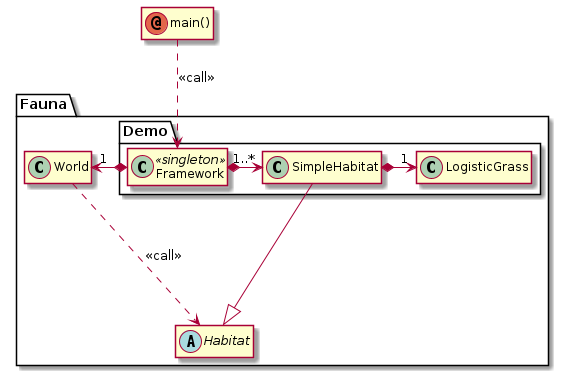
The demo simulator classes are all in the namespace Fauna::Demo. The central class running the program is Fauna::Demo::Framework. It employs Fauna::World to execute the megafauna simulation.
The class Fauna::Demo::SimpleHabitat implements a very basic vegetation model that can be parametrized with custom parameters in the instruction file. Only this one kind of vegetation model is implemented. Grass growth with a logistic growth function:
The SimpleHabitat class corresponds to the LPJ-GUESS Patch.
Each “habitat group” can be considered a list of Fauna::Demo::SimpleHabitat objects. The “habitat group” corresponds conceptually to the LPJ-GUESS Gridcell.
Each aggregation unit (habitat group) comprises several habitats. Since all habitats have the same properties and there is no stochasticity, the output from all aggregation units will look the same.
Parameters
An example instruction file is provided in examples/demo_simulation.toml. It is completely separate from the megafauna library instruction file, It emulates the scenario of the metaphysiological model by Norman Owen-Smith [47] during growing season.
- Copyright
 This software documentation is licensed under a Creative Commons Attribution 4.0 International License.
- Date
- 2019