Function object to calculate herbivore mortality after Illius & O’Connor (2000) After Illius & O'Connor (2000)[35] :
“Mean body fat is assumed to be normally distributed with standard deviation σ (sigma). Mortality occurs in the proportion of animals in the tail of this distribution that projects below zero.”
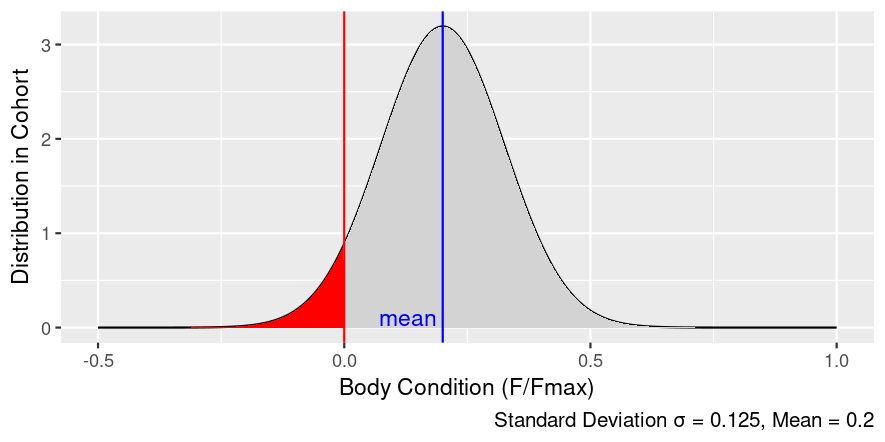
Starvation mortality
after Illius & O’Connor (2000). The red area indicates the dying part of the cohort. SD = standard deviation."
<H1> Shift Body Condition </H1>
\note The following extension to the mortality model is by Wolfgang
:w
When the herbivores with a “negative body condition” die, the cohort
mean would increase. To account for that, the switch
<tt>shift_body_condition</tt> can be turned on in the constructor.
This will change the body condition <tt>b</tt> to the following new value
<tt>b_new</tt>.
\iline 101 \iline 102 \_form#70@_fakenl@_fakenl
\_form#71 is the fraction that died.
<H2> Idea </H2>
Body fat of the dying animals is considered zero, even though
the normal distribution curve suggests mathematically negative values.
But in reality, there is no negative body fat.
The total amount of body fat (kg/km²) in the cohort stays the same
after starvation death. It gets “redistributed” among the surviving
animals.
Be \_form#72 the individual density [ind/km²] and \_form#73 the
body fat as kg/ind. Then \_form#74 is the fat in kg/km².
\_form#75 is the density of the survivors.
\iline 121 \iline 122 \_form#76@_fakenl@_fakenl
Since all animals of one cohort have the same structural body mass
(kg/ind) and fractional maximum body fat, the potential total fat
mass (kg/kg) is the same for all individuals. Therefore:
\iline 128 \iline 129 \iline 130 \_form#77@_fakenl@_fakenl@_fakenl
The two figures below show how the body condition gets shifted after
applying mortality.
The absolute shift in body condition, \_form#78,
has a peak where both starvation mortality and body reserves are
relatively high. The curve tapers down towards lower mortality (to
the right) as well as towards lower body fat (to the left).
The absolute shift is the indicator for the effect of the shift on
the population dynamic. Once the fat reserves of the cohort drop
below the peak, chances for recovery are lower.
@image html starvation_body_condition_shift_abs.png "Absolute change in body condition after removing the dead fraction of the cohort. Standard deviation = 0.125"
@image html starvation_body_condition_shift_rel.png "Relative change in body condition after removing the dead fraction of the cohort. Standard deviation = 0.125"
- Note
- This class only makes sense for herbivore cohorts.