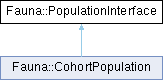
A container of herbivore objects. More...
#include <population_interface.h>
Public Member Functions | |
| virtual | ~PopulationInterface () |
| Virtual destructor. More... | |
| virtual void | create_offspring (const double ind_per_km2)=0 |
| Give birth to new herbivores. More... | |
| virtual void | establish ()=0 |
| Create a set of new herbivores to establish a population. More... | |
| virtual const double | get_ind_per_km2 () const |
| Get individual density of all herbivores together [ind/km²]. More... | |
| virtual const double | get_kg_per_km2 () const |
| Get mass density of all herbivores together [kg/km²]. More... | |
| virtual ConstHerbivoreVector | get_list () const =0 |
| Get pointers to the herbivores (including dead ones). More... | |
| virtual HerbivoreVector | get_list ()=0 |
| Get pointers to the herbivores (including dead ones). More... | |
| virtual void | kill_all () |
| Mark all herbivores as dead (see HerbivoreInterface::kill()). More... | |
| virtual void | kill_nonviable ()=0 |
| Mark those herbivores as dead that are not viable. More... | |
| virtual void | purge_of_dead ()=0 |
| Delete all dead herbivores. More... | |
Detailed Description
A container of herbivore objects.
Manages a set of HerbivoreInterface instances. What makes a "population" may be defined by the derived class. For instance, herbivore cohorts have one population per HFT in each simulation unit.
A population also instantiates all new objects of herbivore classes (derived from HerbivoreInterface) in a simulation.
- Note
- This is strictly speaking no “interface” anymore since not all of its functions are pure abstract. It is just unnecessary effort to change the name.
Constructor & Destructor Documentation
◆ ~PopulationInterface()
|
inlinevirtual |
Virtual destructor.
Destructor must be virtual in an interface.
Member Function Documentation
◆ create_offspring()
|
pure virtual |
Give birth to new herbivores.
The new herbivores are owned by this population object.
- Parameters
-
ind_per_km2 Offspring amount [ind/km²].
- Exceptions
-
std::invalid_argument If offspring<0.0.
Implemented in Fauna::CohortPopulation.
◆ establish()
|
pure virtual |
Create a set of new herbivores to establish a population.
- Exceptions
-
std::logic_error If this population is not empty.
Implemented in Fauna::CohortPopulation.
◆ get_ind_per_km2()
|
virtual |
Get individual density of all herbivores together [ind/km²].
◆ get_kg_per_km2()
|
virtual |
Get mass density of all herbivores together [kg/km²].
◆ get_list() [1/2]
|
pure virtual |
Get pointers to the herbivores (including dead ones).
- Warning
- The pointers are not guaranteed to stay valid on changing the population in create_offspring() or establish().
- Returns
- Pointers to all living herbivores in the population. Guaranteed no NULL pointers.
Implemented in Fauna::CohortPopulation.
◆ get_list() [2/2]
|
pure virtual |
Get pointers to the herbivores (including dead ones).
- Warning
- The pointers are not guaranteed to stay valid on changing the population in create_offspring() or establish().
- Returns
- Pointers to all living herbivores in the population. Guaranteed no NULL pointers.
Implemented in Fauna::CohortPopulation.
◆ kill_all()
|
virtual |
Mark all herbivores as dead (see HerbivoreInterface::kill()).
◆ kill_nonviable()
|
pure virtual |
Mark those herbivores as dead that are not viable.
The first step is to mark non-viable herbivores as dead (see HerbivoreInterface::kill()). In the second step, dead herbivores are removed. It is necessary to split this up so that the simulation framework can do something with dead herbivores before they are deleted in purge_of_dead(). For example this may be returning nitrogen.
Implemented in Fauna::CohortPopulation.
◆ purge_of_dead()
|
pure virtual |
Delete all dead herbivores.
- See also
- HerbivoreInterface::is_dead()
Implemented in Fauna::CohortPopulation.
The documentation for this struct was generated from the following files:
- /home/docs/checkouts/readthedocs.org/user_builds/modular-megafauna-model/checkouts/latest/src/Fauna/population_interface.h
- /home/docs/checkouts/readthedocs.org/user_builds/modular-megafauna-model/checkouts/latest/src/Fauna/population_interface.cpp