Table of Contents
Instructions how expand the code base for your own needs.
Herbivores Tutorials
How to add a new herbivore class
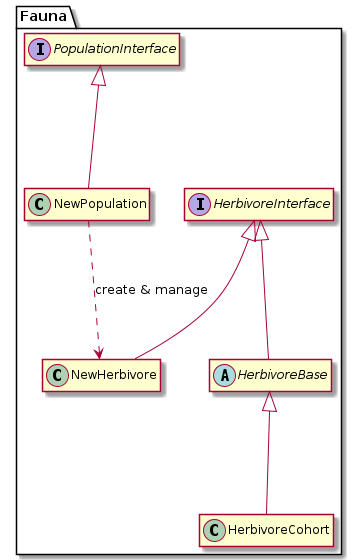
The model design allows a complete substitution of the herbivore class. If you want to implement a completely new model behaviour, you can derive your new class from Fauna::HerbivoreInterface and write it from scratch. If you want to build upon the base functionality, derive it from Fauna::HerbivoreBase.
Then, derive a new class from Fauna::PopulationInterface to manage and construct your object instances. In Fauna::WorldConstructor::create_populations(), create all instances of that population class for one habitat.
How to add a new energy expenditure component
- Add a new enum entry in Fauna::ExpenditureComponent.
- TOML instruction file: Add new possible string value for the HFT parameter
expenditure.componentsin Fauna::InsfileReader::read_hft(); include it in the error message. - Implement your algorithm as a free function or a class. See expenditure_components.h for examples.
- Call your model in Fauna::HerbivoreBase::get_todays_expenditure().
- Update the UML diagram in Section HerbivoreBase.
How to add a new foraging limit
A foraging limit constrains the daily uptake of forage mass by a herbivore individual. Foraging limits are implemented as functors (without using the strategy design pattern, though). Which ones are activated is defined by foraging.limits in Fauna::Hft. They are called in Fauna::GetForageDemands::get_max_foraging().
- Add a new enum entry in Fauna::ForagingLimit.
- TOML instruction file: Add a new possible string value for the HFT parameter
foraging.limitsin Fauna::InsfileReader::read_hft() - Implement your foraging limit (preferably as a function object in the file foraging_limits.h, but you can do as you wish). Make sure that an exception is thrown if it is called with an unknown forage type.
- Call your implementation in Fauna::GetForageDemands::get_max_foraging().
- Update the UML diagram in HerbivoreBase.
How to add a new digestive limit
On top of foraging limitations, the daily forage uptake can be constrained by maximum digestive throughput. The implementation is almost parallel to a foraging limit.
- Add a new enum entry in Fauna::DigestiveLimit.
- Read the new value for
digestion.limitfrom the TOML instruction file in Fauna::InsfileReader::read_hft(). - Implement your digestive limit algorithm as a free function or an object. If it is not much code, put it in foraging_limits.h, otherwise create a new file for it. Make sure that an exception is thrown if it is called with an unknown forage type.
- Call your implementation in Fauna::GetForageDemands::get_max_digestion().
- Update the UML diagram in HerbivoreBase.
How to add a new reproduction model
A reproduction model defines the offspring per female individual for each simulation day.
- Create a new enum entry in Fauna::ReproductionModel.
- Read the new value for
reproduction.modelfrom the instruction file in Fauna::InsfileReader::read_hft(). - Create your class or function in reproduction_models.h or in a separate file.
- Call your model in Fauna::HerbivoreBase::get_todays_offspring_proportion().
- Update the UML diagram in HerbivoreBase.
How to add a new diet composer
In a scenario with multiple forage types, the herbivore decides what to include in its diet. This decision is modelled by an implementation of a so called “diet composer model”: Fauna::DietComposer. You can implement your own model as a new class or a simple function; just call it in Fauna::GetForageDemands::get_diet_composition().
- Create a new enum entry in Fauna::DietComposer.
- Read the new value for
foraging.diet_composerin Fauna::InsfileReader::read_hft(). - Call your model in Fauna::GetForageDemands::get_diet_composition().
- Update the UML diagram in HerbivoreBase.
How to add a new mortality factor
Any death event of an herbivore is modelled by a mortality factor. Whether you want to have herbivores die by for instance disease, drought, or predators, you should create a new mortality factor.
- Create a new enum entry in Fauna::MortalityFactor.
- Parse the new possible value for the set
mortality.factorsin Fauna::InsfileReader::read_hft(). - Implement your mortality model as a function or class in mortality_factors.h or in a separate file (if it’s more complex).
- Call the mortality factor in Fauna::HerbivoreBase::apply_mortality_factors_today().
- Update the UML diagram in HerbivoreBase.
Forage Tutorials
How to add a new forage type
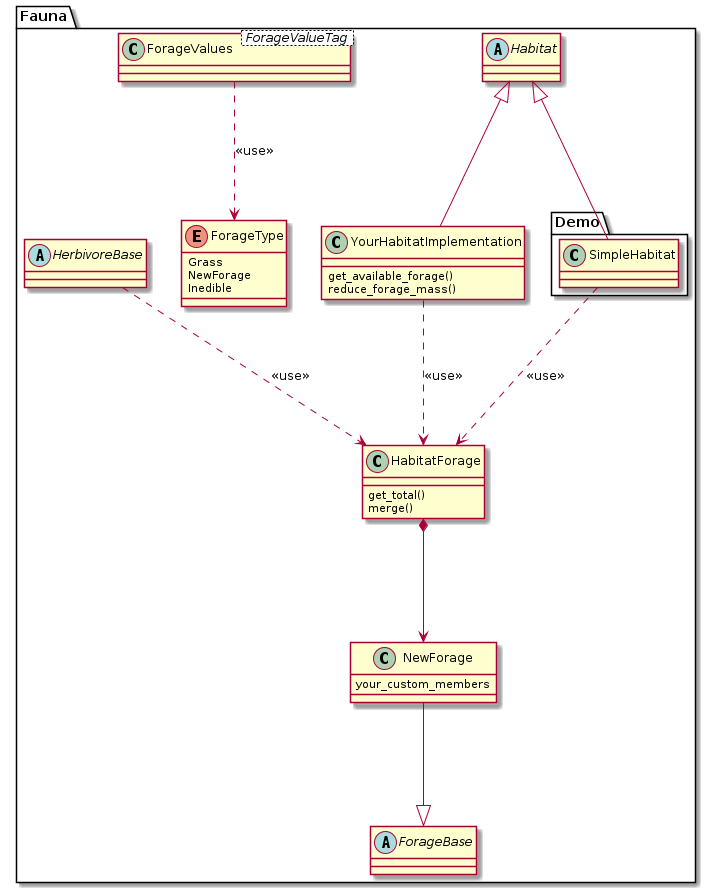
- Create new enum entry in Fauna::ForageType and add it to Fauna::FORAGE_TYPES by expanding the initializing function
get_all_forage_types(), which is declared in local namespace in forage_types.cpp. - Add a short name without blanks in Fauna::get_forage_type_name().
- Derive new class from Fauna::ForageBase.
- Implement a
merge()method, like Fauna::GrassForage::merge().
- Implement a
- Add a new member variable in Fauna::HabitatForage of that class.
- Add it in Fauna::HabitatForage::operator[]().
- Call your
merge()function in Fauna::HabitatForage::merge().
- Adjust the implementation of Fauna::Habitat::get_available_forage() and Fauna::Habitat::remove_eaten_forage() in your vegetation model.
- For Fauna::NetEnergyModel::GrossEnergyFraction you will need to define a value for the parameter
forage.gross_energy.new_forage_typein the TOML file. - Herbivores
- Check all foraging and digestion limits (foraging_limits.h) whether they need to be expanded.
- Probably you will need to implement a new diet composer or adjust existing ones.
- Test Simulations
- If you want to use your forage type in the demo simulations, expand Fauna::Demo::SimpleHabitat by a new growth model (analoguous to Fauna::Demo::LogisticGrass). Also update the UML diagram in the class documentation of
SimpleHabitat.
- If you want to use your forage type in the demo simulations, expand Fauna::Demo::SimpleHabitat by a new growth model (analoguous to Fauna::Demo::LogisticGrass). Also update the UML diagram in the class documentation of
How to change forage net energy content
- Implement your model in a function or class in the file net_energy_models.h.
- Add a new enum item in Fauna::NetEnergyModel.
- Parse that value for the HFT parameter
digestion.net_energy_modelin Fauna::InsfileReader::read_hft(). - Execute your function or class in Fauna::HerbivoreBase::get_net_energy_content().
- Update the UML diagram in HerbivoreBase.
How to add a new forage distribution algorithm
- Derive a new class from Fauna::DistributeForage and implement your algorithm. If the algorithm is not too big, put it in forage_distribution_algorithms.h, otherwise create a new set of files.
- Return a reference to an object of your class in Fauna::WorldConstructor::create_distribute_forage() if it is selected in the parameters.
- Add a new enum entry in Fauna::ForageDistributionAlgorithm.
- Parse your new value from the parameter
simulation.forage_distributionin Fauna::InsfileReader::read_hft().
Parameters Tutorials
How to add a new global parameter
- Declare your parameter as a member variable in Fauna::Parameters and initialize it with a valid default value. The
enum classtype for Enum parameters should be declared in parameters.h. - Write a validity check in Fauna::Parameters::is_valid().
- Parse the parameter from the TOML instruction file in Fauna::InsfileReader. General parameters are parsed in Fauna::InsfileReader::read_table_simulation().
- If you are creating a whole new set of parameters, it might make sense to group them in a TOML table. Existing tables are
outputandsimulation. You should then write a new private member function similar to Fauna::InsfileReader::read_table_simulation().
- If you are creating a whole new set of parameters, it might make sense to group them in a TOML table. Existing tables are
How to add a new HFT parameter
- Declare a new member variable in Fauna::Hft and initialize it with a valid default value. The
enum classtype for Enum parameters should be declared in hft.h. - Write a validity check in Fauna::Hft::is_valid().
- See also
- Parameters
Output Tutorials
How to add a new output variable
After separating the megafauna model from LPJ-GUESS into its own library only a minimal set of variables are made available for output. If your variable of interest is already present in Fauna::Output::HabitatData or Fauna::Output::HerbivoreData, then you can skip the first step in the following tutorial.
- Extend the appropriate container: Fauna::Output::HabitatData or Fauna::Output::HerbivoreData by a new member variable and initialize it with zero.
- Add it in the
reset()function. - Implement average building in the appropriate
merge()function. - For herbivore data, you need to add it to Fauna::Output::HerbivoreData::create_datapoint(). If your value is per individual, you will need to weight the value by individual density; if it is per area or per habitat, you can calculate the sum.
- Assign a value to the variable somewhere in daily simulation.
- Add it in the
- Write the variable in Fauna::Output::TextTableWriter.
- Add a selector for your new output file as a boolean member variable in Fauna::Output::TextTableWriterOptions. Pay attention to place it in the right Doxygen group.
- Parse the name of the selector in Fauna::InsfileReader::read_table_output_text_tables() and add it there to the valid options in the error message.
- Optional: Consider adding it in the example output in the file
examples/megafauna.tomland plotting it intools/demo_simulator/demo_results.Rmd. In that case the output file needs to be listed as an artifact in.gitlab-ci.ymlunder the job “demo_simulation”. - Add an output file stream (
std::ofstream) for your variable as a private member variable in Fauna::Output::TextTableWriter. - In the constructor Fauna::Output::TextTableWriter::TextTableWriter(), add your new output file to the list of file streams if it is selected in the options.
- Initialize the column captions of your new file in Fauna::Output::TextTableWriter::write_captions().
- Write the data to the file in Fauna::Output::TextTableWriter::write_datapoint().
- Note
- If you want to add a variable that is not per herbivore mass, you would have to use mass density as weight.
How to write output to another format
The default output format are very simple tab-separated plaintext tables. The class Fauna::Output::TextTableWriter is responsible for this format. However, you can also replace that output format with another one, for instance writing to a NetCDF file or forwarding it to another program or library.
- Derive a new class from Fauna::Output::WriterInterface.
- Add a new enum entry to Fauna::OutputFormat.
- Parse the new option in Fauna::InsfileReader::read_table_output().
- Create a new instance of your writer class in the constructor Fauna::World::World() if your enum entry is selected.
- See also
- Output design
- Copyright
 This software documentation is licensed under a Creative Commons Attribution 4.0 International License.
- Date
- 2019